Send Anywhere Alternative in India: The 2026 Guide to Persistent B2B File Delivery
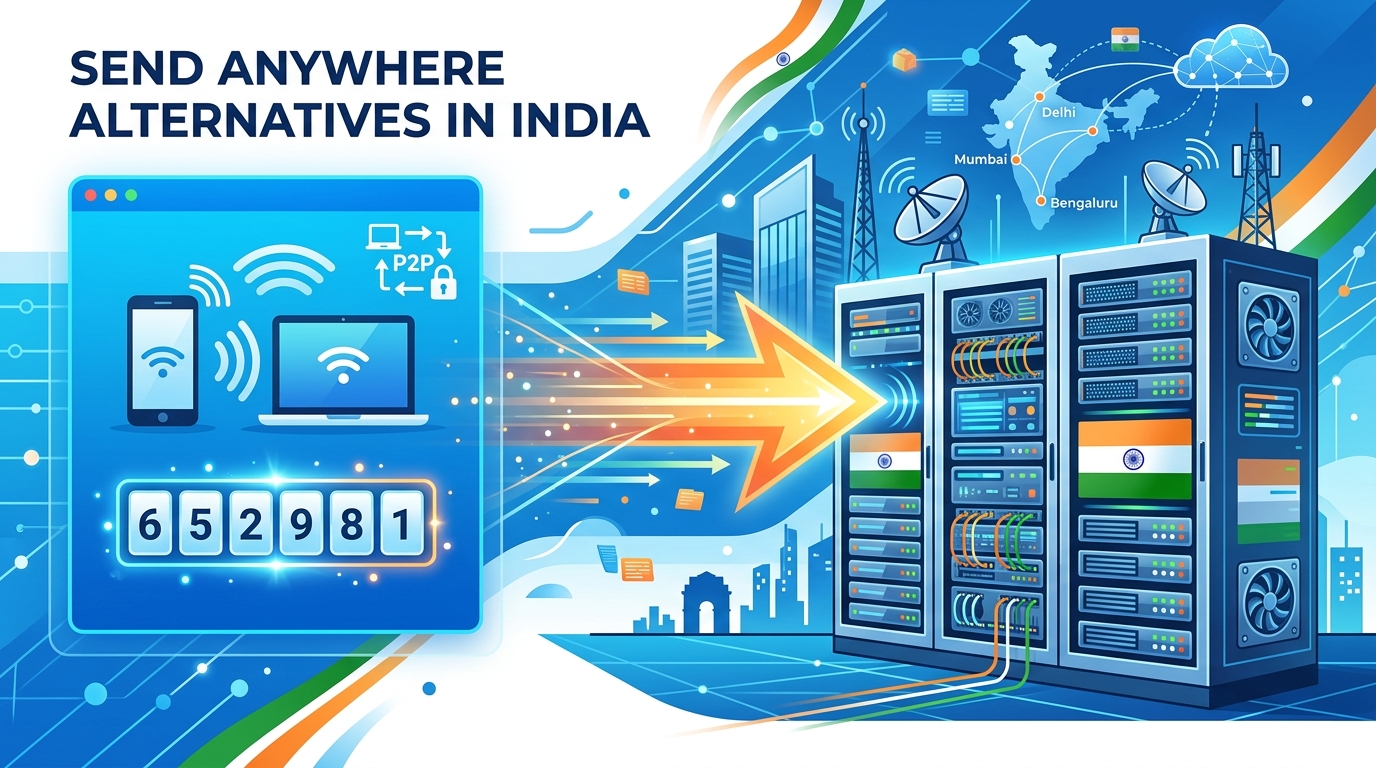
Send Anywhere carved out a highly specific niche in the file-sharing market: real-time, peer-to-peer (P2P) transfers using a temporary 6-digit key. If you need to quickly beam a folder of photos from an Android phone to a Windows laptop in the same room, it is remarkably efficient.
However, scaling a 6-digit transient transfer tool into a professional commercial workflow creates immediate bottlenecks. If an Indian design studio needs to deliver a massive uncompressed Cinema 4D project to a client, or a software agency wants to securely share custom Go and Python implementations with a remote team, Send Anywhere falls drastically short. The 10-minute expiry keys, ad-heavy receiver screens, and lack of persistent background synchronization make it unsuitable for serious business operations.
If you are an Indian IT firm, agency, or professional looking to replace transient file transfer tools with a unified, secure, and sovereign cloud workspace, here is the complete 2026 breakdown of Send Anywhere versus domestic alternatives.
1. Who is Send Anywhere for?
Send Anywhere (now managed under Rakuten Symphony) is built for casual users, students, and device hoppers who need ad-hoc, real-time file transfers. Its primary use case is bypassing messy USB cables to move files between a smartphone and a PC, or sending a quick file to a peer who is simultaneously online and ready to enter a 6-digit code.
2. What does it cost?
The core 6-digit transfer service is free, but heavily ad-supported.
- Send Anywhere PRO: Costs around $5.99 to $9.99 / month (approx. ₹500 - ₹850) depending on the billing cycle.
- The Forex Tax: Paid tiers are billed in USD. Indian professionals and small businesses are forced to absorb 1.5% to 3.5% foreign transaction markups on their corporate cards with every renewal.
3. Where is data stored?
Because of its P2P nature, 6-digit transfers ideally route directly between devices. However, when you generate a "Share Link" for offline downloading, your data is uploaded to Send Anywhere's servers, which are primarily located in South Korea and the United States (AWS). Exporting sensitive Indian corporate assets or regulated client data to foreign servers introduces unnecessary exposure under India's Digital Personal Data Protection Act (DPDPA).
4. Encryption model
Send Anywhere uses standard Server-Side Encryption (TLS in transit). If a file touches their servers via a share link, they hold the decryption keys. They do not provide client-side Zero-Knowledge encryption, meaning your proprietary codebase, unreleased campaign assets, or confidential legal documents are technically accessible by the platform's automated systems.
5. Backup & Sync Experience (The Critical Missing Piece)
Send Anywhere is a transit pipe, not a cloud drive. It offers zero persistent background synchronization. If your developers are coding custom PHP or Python backend scripts, or your designers are working in After Effects, Send Anywhere cannot actively back up those working directories. You are completely exposed to local hard drive failure until the project is manually zipped and transferred.
6. File Sharing
The file-sharing experience for external clients is notoriously disjointed.
- 6-Digit Keys: Expire in exactly 10 minutes. Both parties must be online concurrently, which is impossible for asynchronous B2B client deliveries.
- Link Sharing: Links typically expire in 48 hours for free users. Worse, clients who click your link are greeted by a web page cluttered with aggressive display ads and confusing banner placements, severely degrading your agency's professional image.
7. Storage Limits
Free link sharing is capped at 10GB per link. PRO plans bump link sizes to 50GB and provide 1TB of link storage. But again, this storage is merely a temporary holding buffer for transfers, not a mountable, syncable drive for active business use.
8. India-Specific Advantages & Disadvantages
- Advantage (Device Agnostic): Very easy to move a file from an iOS device to a Windows PC instantly if both users are in the same physical office.
- Disadvantage (Client Friction): Indian corporate clients do not want to navigate ad-riddled pages or coordinate their schedules to enter a 10-minute access code.
- Disadvantage (Latency): Generating a persistent share link pushes your data to servers in South Korea or the US, resulting in sluggish upload speeds for large media files over Indian broadband.
- Disadvantage (Tax Compliance): Billed by a foreign entity in USD. Your business cannot generate a localized B2B tax invoice to instantly secure GST-compliant B2B invoices in the future.
9. Who should choose Send Anywhere?
You should use Send Anywhere if you are a casual consumer looking for a quick, free way to move a video from your smartphone to your laptop across the room, and you don't mind navigating banner ads to do so.
10. Who should choose QuixiCloud?
You should choose QuixiCloud if you are operating a serious business or agency in India that needs to unify persistent, automated project backups with highly professional, ad-free client delivery.
- Unified Active Sync & Delivery: Eliminate the gap between where you work and how you share. The QuixiCloud Sync engine continuously backs up your active local projects via lightweight delta-sync. When a project is ready for delivery, simply right-click to generate a clean, ad-free download link directly from your synchronized vault.
- Total Access Control: Never force a client to race against a 10-minute timer. QuixiCloud lets you set custom 24-hour or 48-hour self-destruct timers and password protection, giving you complete control over your intellectual property.
- Seamless Mobile Management: With the unified QuixiCloud Sync mobile application (v1.0.2), you can generate, manage, or revoke secure client links directly from your smartphone, ensuring your business keeps moving even when you are away from your workstation.
- Fortified Sovereign Backend: Delivered by QUIXICLOUD DATA STORAGE (OPC) PRIVATE LIMITED, your data resides strictly on Tier-1 Indian infrastructure (Mumbai, Delhi, and Bangalore) utilizing the Zettabyte File System (ZFS) to prevent silent bit rot. The backend server environment is rigorously secured with custom Nginx log monitoring and Fail2Ban intrusion prevention, keeping your corporate assets locked down.
- Native INR Billing: QuixiCloud operates natively on domestic payment rails. Pay predictably in INR via Razorpay and receive automated B2B tax invoices instantly, allowing your finance team to effortlessly support GST-compliant B2B invoicing.
Stop Using Ad-Supported Transit Pipes for Corporate Files
Consolidate your active workstation backups and client file deliveries into one high-speed, secure platform hosted on sovereign Indian infrastructure.
Start Your Free QuixiCloud Business Trial — Deploy on Mumbai, Delhi, and Bangalore servers today. GST-compliant B2B invoicing coming soon.
Explore More: QuixiCloud Plans · Secure Cloud Storage
Written by QuixiCloud Team
The QuixiCloud India Engineering Team is dedicated to building secure, scalable, and privacy-first cloud storage solutions tailored for Indian businesses and users.