Nextcloud Alternative in India: The 2026 Guide to Managed vs. DIY Private Cloud
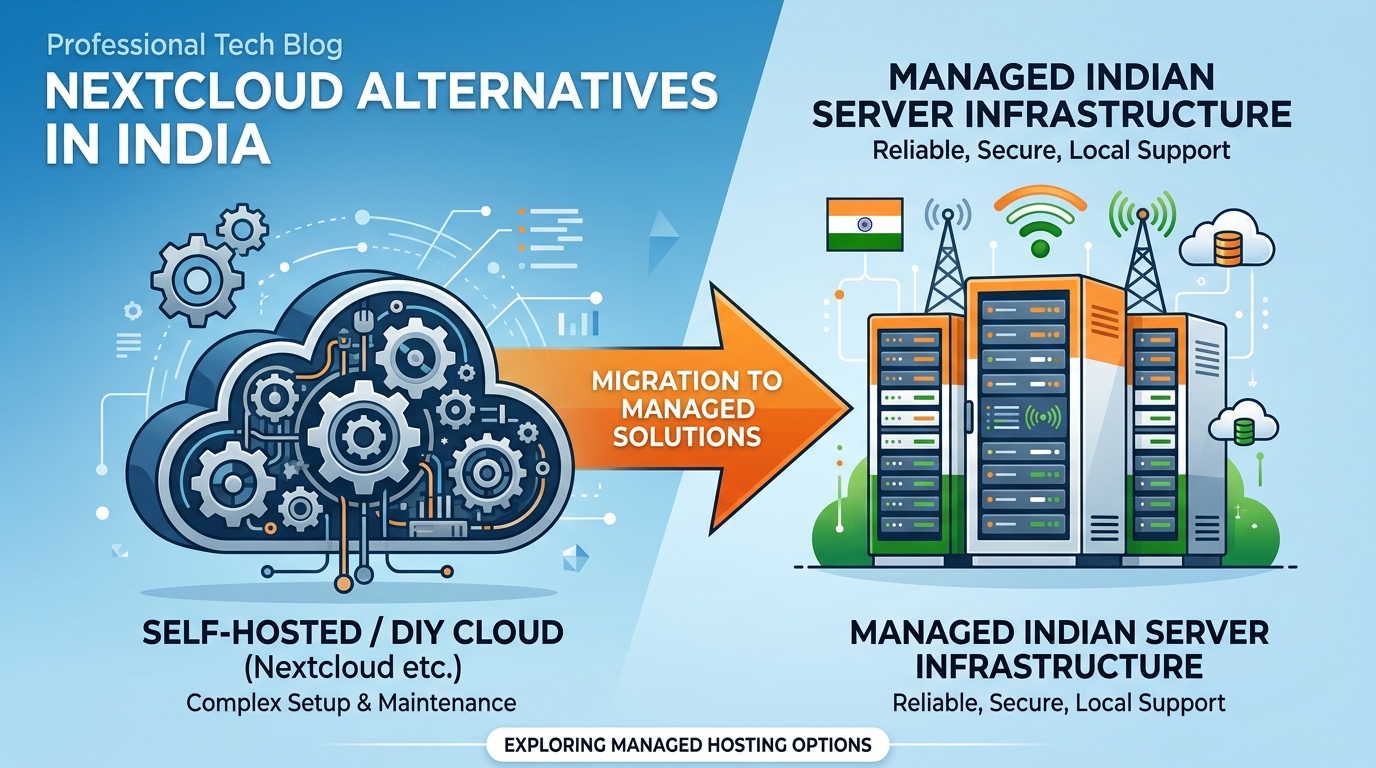
For organizations that refuse to surrender their data to global hyperscalers like Google or Microsoft, Nextcloud has long been the gold standard for open-source, self-hosted file sharing. It allows you to build your own private cloud on your own hardware.
However, the reality of self-hosting is that "free software" is never truly free. Running Nextcloud in a production business environment shifts the entire operational burden onto your internal IT team. You are no longer just paying for storage; you are paying in engineering hours to maintain PHP dependencies, monitor Nginx logs, deploy Fail2Ban to block brute-force SSH attacks, and manage complex database backups.
For Indian design studios, software firms, and SMBs that want the total control and privacy of a self-hosted cloud—but without the exhausting sysadmin and DevOps maintenance burden—here is the complete 2026 breakdown of Nextcloud versus sovereign managed alternatives.
1. Who is Nextcloud for?
Nextcloud is built for IT departments, DevOps engineers, and "homelab" tinkerers who demand absolute control over their infrastructure. It is a highly modular, open-source platform that functions more like a self-hosted operating system (with plugins for calendars, kanban boards, and chat) rather than just a focused file-sync engine.
2. What does it cost?
The Nextcloud software itself is free and open-source, but the Total Cost of Ownership (TCO) is high:
- Infrastructure Costs: You must rent your own VPS (Virtual Private Server) or bare-metal servers, plus the block/object storage attached to it.
- Labor Costs: You need a dedicated sysadmin to install updates, manage the LAMP/LEMP stack (Linux, Apache/Nginx, MariaDB, PHP), and secure the perimeter.
- Nextcloud Enterprise: If you want official support or enterprise compliance patches, Nextcloud Enterprise pricing is billed in Euros (EUR) and typically starts at around €3,000 to €5,000+ per year (₹2.7 Lakhs+), requiring a minimum of 100 users.
3. Where is data stored?
Exactly where you choose to put it. You can install Nextcloud on a physical NAS in your office closet, or deploy it on an Indian VPS provider. This gives you excellent potential for data sovereignty, provided you properly configure the underlying server environment.
4. Encryption model
By default, Nextcloud uses Server-Side Encryption. Because you own the server, this is generally secure from outside corporations, but your server admin still has access to the plaintext files. Nextcloud does offer an End-to-End Encryption (E2EE) plugin for client-side zero-knowledge, but it is notoriously finicky. It frequently breaks during major version upgrades, lacks support for web-browser viewing, and can cause severe database locking issues.
5. Backup & Sync Experience
Nextcloud offers solid desktop and mobile sync clients. However, the reliability of your sync experience depends entirely on how well you have optimized the backend database (like configuring Redis for memory caching and tuning PHP workers). If an update breaks the database schema, your entire team's sync clients will instantly go offline until your sysadmin fixes the server.
6. File Sharing
Nextcloud’s file sharing is incredibly feature-rich, offering public links, password protection, and upload-only folders. You can also install plugins to collaborate on office documents directly in the browser, provided you are willing to set up and maintain a separate Collaborative Office Document server (like Collabora or ONLYOFFICE).
7. Storage Limits
Your storage limits are dictated entirely by the size of the hard drives you buy or the block storage volume you rent from your VPS provider. You can scale endlessly, but you are responsible for migrating the databases and mounting the new storage volumes safely.
8. India-Specific Advantages & Disadvantages
- Advantage (Sovereignty): You can rent a server in Mumbai and achieve 100% Indian data residency, satisfying DPDPA rules.
- Disadvantage (Maintenance Burden): Finding and retaining Indian DevOps talent to exclusively manage a self-hosted Nextcloud instance is expensive and distracts your engineers from building your actual core product.
- Disadvantage (Tax & Support): If your business scales and you require Nextcloud Enterprise support, paying in Euros means dealing with forex markups, and getting automated B2B GST Invoicing on European software licenses is a complex accounting chore.
- Disadvantage (Data Integrity): Unless your sysadmin specifically builds your Nextcloud server on top of a custom ZFS storage array, deploying on standard Linux ext4 file systems leaves your corporate data vulnerable to silent hardware bit rot.
9. Who should choose Nextcloud?
You should choose Nextcloud if you have a dedicated, in-house DevOps team, you want to host an entire suite of applications (chat, calendar, mail, file sync) on a single server, and you are comfortable with the ongoing labor required to patch software vulnerabilities, tune databases, and configure security firewalls manually.
10. Who should choose QuixiCloud?
You should choose QuixiCloud if you want the absolute privacy and local control of a private cloud, but you want it delivered as a frictionless, fully managed service.
- Zero Sysadmin Headache: We manage the servers, the security patches, the Nginx reverse proxies, and the intrusion prevention. Your team simply installs the QuixiCloud Sync app and gets straight to work.
- Native Zero-Knowledge Encryption: Unlike Nextcloud's buggy E2EE plugin, QuixiCloud enforces rock-solid, client-side AES-256 encryption natively. Even though we manage the infrastructure, we mathematically cannot read your files.
- Enterprise ZFS Pre-Configured: QuixiCloud’s Mumbai, Delhi, and Bangalore servers run on the Zettabyte File System out of the box. You get RAM ARC caching and Copy-on-Write (CoW) protection against bit rot without having to build or configure a custom Linux storage array yourself.
- S3-Compatible Automation: Easily plug in custom Go or Python backend scripts and backup pipelines using standard S3 API endpoints, avoiding complex WebDAV limitations.
- Native INR Billing: Skip the expensive European enterprise licenses. QuixiCloud provides flat-rate INR billing via Razorpay, delivering automated B2B tax invoices so you can instantly secure future B2B GST tax invoices.
Stop Managing Servers. Start Managing Your Business.
Get the privacy of a self-hosted cloud with the frictionless speed of managed ZFS infrastructure.
Start Your Free QuixiCloud Business Trial — Deploy on Tier-1 Mumbai, Delhi, and Bangalore servers today. Zero maintenance, zero egress fees, and GST-compliant B2B invoicing coming soon.
Explore More: QuixiCloud Plans · Secure Cloud Storage
Written by QuixiCloud Team
The QuixiCloud India Engineering Team is dedicated to building secure, scalable, and privacy-first cloud storage solutions tailored for Indian businesses and users.