Cloud Storage with Indian Servers: Low Latency, Data Sovereignty & Enterprise Performance
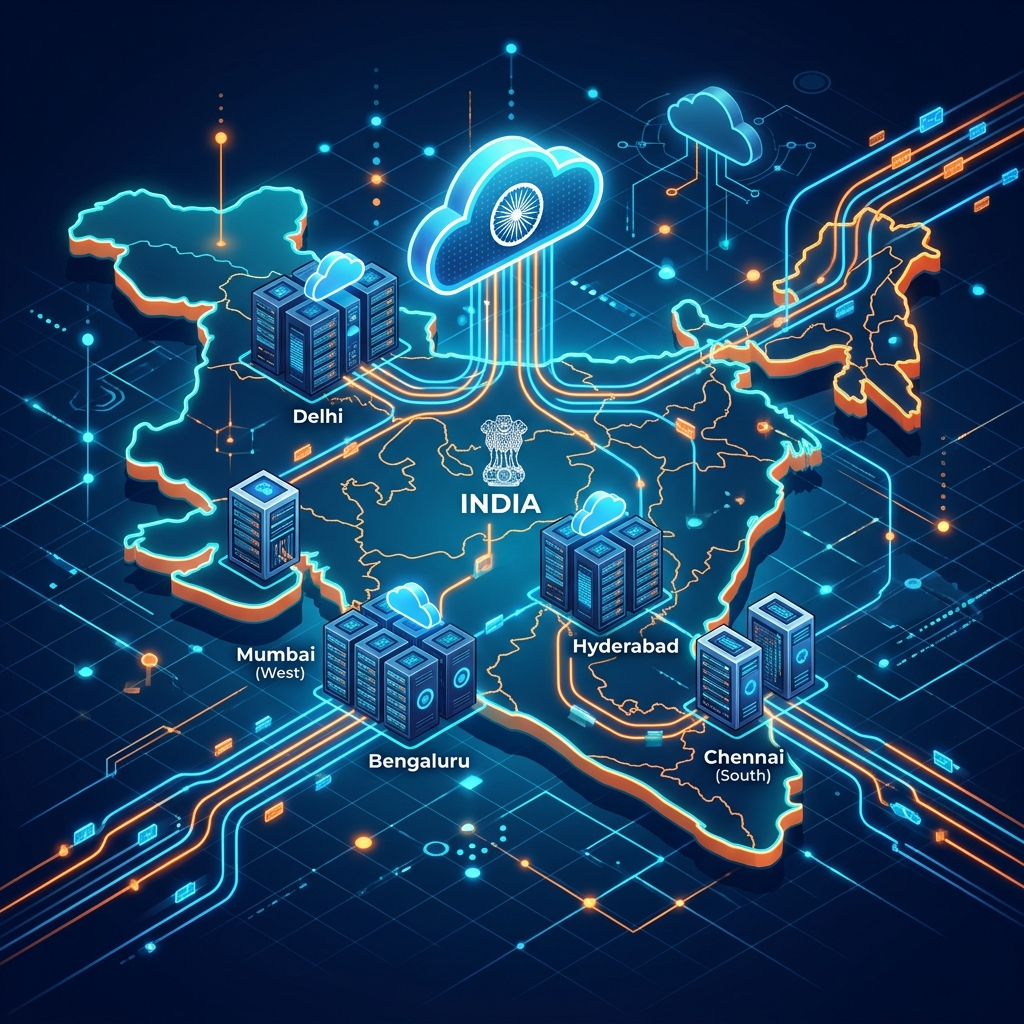
When choosing enterprise or professional cloud storage in India, physical server location is not just a technical footnote—it directly governs your day-to-day upload speeds, network latency, regulatory risk, and data sovereignty.
For years, businesses across India relied on international providers that routed traffic through overseas routing nodes or treated India as an afterthought region. But as data transfer volumes surge and India’s regulatory landscape matures under the Digital Personal Data Protection Act (DPDPA), local hosting on domestic soil has become non-negotiable.
Hosting your corporate assets on native Mumbai, Delhi, and Bangalore cloud clusters eliminates the latency penalty of international routing and ensures your data remains protected strictly under Indian legal jurisdiction.
The Latency Physics: Why Indian Server Locations Outperform Global Clouds
Network latency is governed by physical distance and intermediate routing hops.
When your team uploads large CAD schematics, 4K production footage, or SQL database dumps to servers located in North America or Western Europe, each data packet travels thousands of kilometers through subsea fiber cables and dozens of border routers.
International Routing (US / EU Cloud):
[Your Office in India] ──(40-80ms+)──► Undersea Cable ──► Border Gateway ──► Overseas Data Center
* Drawbacks: High Time to First Byte (TTFB), sluggish mobile sync, API lag, packet loss over cellular networks.

Native Indian Infrastructure (QuixiCloud Mumbai / Delhi / Bangalore Clusters):
[Your Office in India] ──(under 5ms)──► Direct Tier-1 Domestic Peering ──► Local ZFS Data Center
* Benefits: Near-zero round-trip time, instant dashboard response, saturated local bandwidth, rock-solid 4G/5G mobile sync.
The Domestic Routing Advantage:
- Sub-5ms Latency: Local hosting in India’s primary internet exchange hubs (Mumbai, Delhi, and Bangalore) drops round-trip ping times to sub-5ms across major metro corridors.
- Instant Time to First Byte (TTFB): Web applications, S3 programmatic requests, and client file access load instantly without the noticeable micro-delays that plague overseas servers.
- Cellular Network Resilience: When field teams or remote staff sync heavy assets over 4G/5G connections, high-latency overseas links cause frequent dropped connections and stalled uploads. Low-latency domestic servers keep data pipelines saturated and resilient.
Data Sovereignty: Physical Residency vs. True Jurisdictional Control
Many organizations operate under the mistaken belief that merely selecting an "ap-south-1 (Mumbai)" region inside a US-based cloud hyperscaler shields their data from foreign intervention. It does not.
- The US CLOUD Act Threat: Under the Clarifying Lawful Overseas Use of Data (CLOUD) Act, US-headquartered technology giants are legally required to surrender data under their control to US federal authorities, regardless of whether that data physically rests in Mumbai or Frankfurt. If foreign entities issue a subpoena, your local residency offers zero legal shield.
- True Indian Sovereignty: A sovereign domestic cloud provider operating exclusively on Indian soil is bound solely by the Constitution and laws of India. Your proprietary trade secrets, client litigation records, and citizen personal data are protected by Indian courts and cannot be unilaterally extracted via foreign legal mandates.
Infrastructure Comparison: Indian Servers Compared
| Evaluation Metric | Global Hyperscalers (AWS / Azure) | Consumer US Drives (Google Drive) | QuixiCloud Native Indian Infrastructure |
|---|---|---|---|
| Physical Server Nodes | Mumbai / Hyderabad | Global / Hybrid CDN Nodes | Tier-1 Mumbai & Bangalore Clusters |
| Legal Jurisdiction | Foreign Extraterritoriality (US CLOUD Act) | Foreign Extraterritoriality (US CLOUD Act) | 100% Sovereign Indian Legal Jurisdiction |
| Underlying File System | Proprietary Object Storage | Proprietary Distributed FS | Enterprise ZFS (Self-Healing Copy-on-Write) |
| Memory Caching | Layered Add-ons (ElastiCache / Redis) | Proprietary Indexing | Integrated ZFS ARC (RAM-Speed File Reads) |
| Egress / Download Bandwidth | Punitive ($0.09/GB public internet egress) | Fair-usage throttled | Zero Egress Penalties |
| API Integration | Standard S3 / Complex IAM | Proprietary REST APIs | Standard S3-Compatible Endpoints |
| Currency & Invoicing | USD Billing / Forex markup fees | USD or Reseller Bundled | Direct INR Billing + Future GST Invoicing Support |
High-Performance Architecture: The ZFS Advantage
Server location gets your data to the data center quickly; the underlying file system dictates what happens when it hits the physical disks.
Many legacy cloud servers run standard Linux file systems (like ext4 or XFS) coupled with hardware RAID controllers. Under high concurrent write loads, these systems become major I/O bottlenecks and offer no protection against silent data corruption (bit rot).
QuixiCloud pairs its Mumbai, Delhi, and Bangalore clusters with enterprise ZFS (Zettabyte File System) architecture:
- Adaptive Replacement Cache (ARC): High-frequency reads are served directly from server RAM. If multiple team members or application instances access the same project assets or databases, the data is served from memory at gigabytes per second, bypassing physical drive read delays entirely.
- Copy-on-Write (CoW) Data Integrity: Modifying a file never overwrites active blocks. New data is committed to fresh storage before metadata pointers update. If an abrupt power outage occurs mid-sync, your files remain completely uncorrupted.
- Continuous 256-Bit Block Checksumming: Every data block is verified against a mathematical checksum upon every read and write cycle. If an individual disk sector degrades, ZFS automatically identifies the bit rot and repairs the block using parity in real time.
Seamless Financial & Tax Alignment for Indian Enterprises
Operating on domestic infrastructure should simplify your company’s financial workflow, not complicate it:
- Eliminate Forex Volatility: Stop paying fluctuating USD invoices on international credit cards. QuixiCloud bills purely in stable Indian Rupees (INR) via domestic payment rails like Razorpay.
- Zero Credit Card Markup Fees: Avoid the 1.5% to 3.5% foreign currency transaction markups and additional bank taxes that domestic institutions slap onto overseas SaaS subscriptions.
- Instant B2B GST Invoicing: Save with predictable INR pricing, with GST-compliant B2B invoicing available after our registration is complete, dramatically lowering your net operational costs compared to international providers that do not issue valid Indian tax documentation.
The Verdict: Fast, Sovereign, and Built for India
If your company is operating in India, your storage stack should be designed for India. By combining the low-latency responsiveness of Mumbai, Delhi, and Bangalore server clusters with zero-knowledge encryption and enterprise ZFS horsepower, QuixiCloud delivers a cloud experience that keeps your workflow fast, your budget predictable, and your data legally secure.
Experience Ultra-Low-Latency Storage in India
Deploy your corporate storage on Tier-1 Mumbai & Bangalore server infrastructure today.
Start Your Free QuixiCloud Trial — Sub-5ms latency, full data sovereignty, and GST-compliant B2B invoicing coming soon.
Explore More: Secure Cloud Storage · Automatic Backup
Written by QuixiCloud India
The QuixiCloud India Engineering Team is dedicated to building secure, scalable, and privacy-first cloud storage solutions tailored for Indian businesses and users.